Wedding Gift Ideas Philippines: What to Give at a Filipino Wedding
Cash is the standard Filipino wedding gift, but how much should you give? Amounts by relationship, physical gift ideas, ninong and ninang etiquette, and how to present your gift.
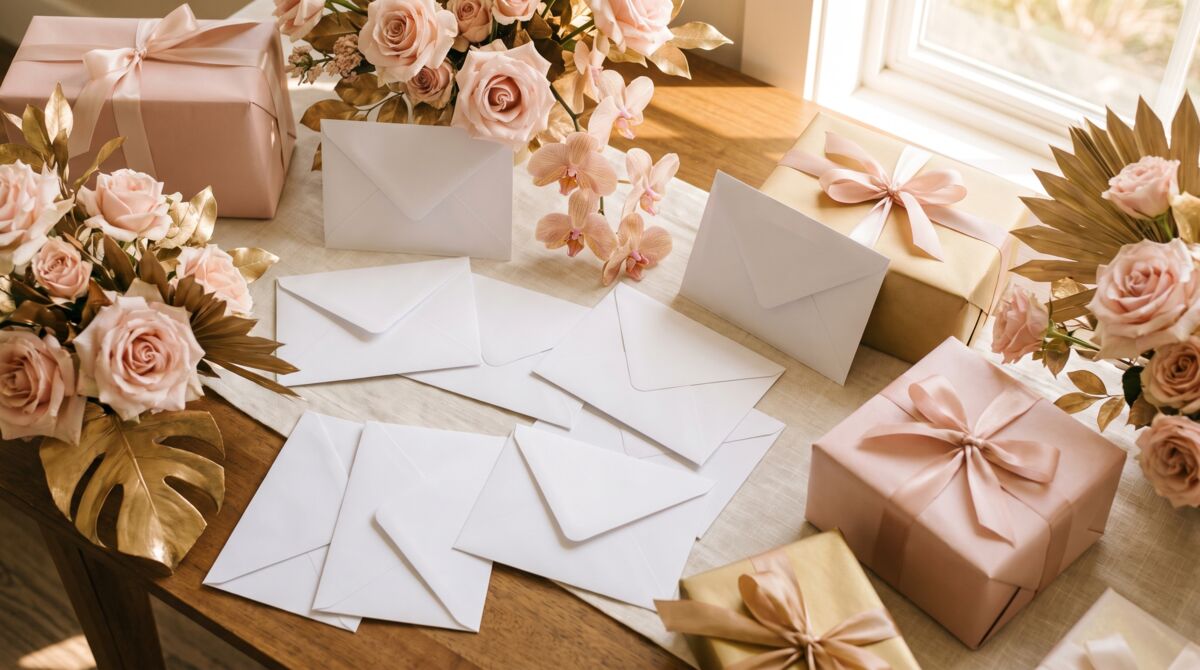
Cash in a white envelope is the standard wedding gift in the Philippines. Most guests give PHP 1,000 to PHP 3,000 per person, while close family and principal sponsors give PHP 5,000 or more. The guiding rule is simple: cover roughly what the couple spent to host you at the reception.
How much cash should you give at a Filipino wedding?
"Cover your plate." That is the unwritten rule. Your cash gift should roughly equal what the couple spent per guest on food and the venue.
A hotel banquet in Makati runs PHP 2,500 to PHP 4,000 per head, while a garden reception in Tagaytay might cost PHP 1,500 to PHP 2,500 and a casual restaurant celebration even less. You will not always know the exact figure, but the venue tells you enough.
| Relationship | Typical amount | Notes |
|---|---|---|
| Casual friend or colleague | PHP 500 to PHP 2,000 | PHP 1,000 is a common baseline |
| Close friend | PHP 2,000 to PHP 5,000 | Closer friends lean toward PHP 3,000+ |
| Extended family | PHP 2,000 to PHP 10,000 | Varies widely by family culture |
| Immediate family | PHP 5,000 to PHP 20,000+ | Parents and siblings often give the most |
| Ninong or ninang | PHP 3,000 to PHP 15,000+ | The ceremonial role carries higher expectations |
These ranges come from community discussions on Filipino wedding forums and etiquette guides. They shift depending on the family, the region, and how close you actually are to the couple, not just how close the seating chart says you are.
If you are attending as a couple, give one combined envelope. The amount reflects two people, but nobody expects you to literally double the single-guest figure.
Why do Filipino couples prefer cash?
The short answer: because it works.
Cash has been the dominant wedding gift in the Philippines for generations. The practice is rooted in abuloy, a tradition of contributing money to help offset celebration costs. Long before Western couples started asking for "honeymoon funds" on their registries, Filipino guests were handing over white envelopes at the reception.
Couples prefer cash because they can put it toward honeymoon expenses, a down payment, or the catering balance they still owe. It also respects the reality that many Filipino couples already share a household before the wedding. They own a rice cooker. Probably two.
The Knot's guide to Filipino wedding traditions puts it plainly: "gifts are typically given during or after the reception," with cash as the predominant form. The tradition runs deep enough that couples rarely need to request it.
Physical gifts are still welcome from some guests, though. Older relatives in particular often prefer giving something tangible. If the invitation mentions a registry, that is the couple telling you they want items, not cash. Read it carefully.
What are good physical gift ideas for a Filipino couple?
The safest category is kitchen appliances. An air fryer runs PHP 2,500 to PHP 5,000, a coffee machine about the same, and either one will get daily use in a small Metro Manila kitchen. Stand mixers are a popular pick for couples who bake together. Multi-cookers work well too, especially for newlyweds still figuring out weeknight dinners.
Quality bedding sets (PHP 3,000 to PHP 6,000) and towel bundles are less exciting but genuinely useful. Skip purely decorative pieces unless you know the couple's taste. Nobody needs another vase.
From close friends and family, personal gifts carry more weight than expensive ones. A framed photo from the engagement shoot, a custom illustration of their ceremony venue, or a handwritten recipe book from the family all say something cash cannot.
For ninong and ninang specifically, religious items are worth considering. Roughly 86% of Filipinos are Catholic, and a Bible or a crucifix for the couple's new home carries real meaning from a sponsor who stood at the altar with them.
Never give knives, scissors, or any sharp objects. In Filipino tradition, these symbolize cutting the relationship. Even an expensive knife set. This taboo is well-documented: John Jonas's writeup on Filipino customs confirms that "the only item that most Filipinos consider bad luck to bring to a wedding is knives, because they symbolize cutting or breaking a relationship."
How much should ninong and ninang give?
The honest answer: more than regular guests.
Principal sponsors witness the vows and often sign the marriage certificate. The role is an honor, but it carries financial weight. Most ninong and ninang give PHP 3,000 to PHP 15,000 or more. Family sponsors often go higher. The Storia blog's ninong and ninang guide puts the range at PHP 10,000 to PHP 20,000+ for close family sponsors, PHP 5,000 to PHP 10,000 for friend sponsors.
Some sponsors contribute to wedding expenses directly instead: paying for the videographer, covering flowers, or funding part of the honeymoon. If you are already shouldering one of these, talk to the couple about whether they also expect a separate envelope. Most will tell you not to worry about it.
Secondary sponsors (the candle, veil and cord pairs) give amounts closer to what close friends or family would give. The financial expectation is lower, even though their ceremonial role is still significant.
Our guide to principal and secondary sponsors covers the full scope of sponsor duties beyond gift-giving.
How do you present your wedding gift?
Most Filipino weddings have a gift box or designated table near the reception entrance, sometimes labeled, sometimes just attended by a tita who knows everyone. Drop your sealed white envelope there. Write your name on the outside so the couple can send thank-you messages later. Do not write the amount.
GCash and Maya have quietly become a second channel. Some couples share their GCash number or bank details on a group chat or wedding website before the event. If you send digitally, add a short note with the transfer ("Wedding gift from the Santos family") so it does not blend into the couple's regular transactions.
Separate from the envelope, there is the money dance. Sabitan ng pera, the prosperity dance. Guests line up to pin cash directly onto the bride's and groom's clothing while dancing with them. Philippine wedding customs on Wikipedia calls it "a way to help the new couple get started with their married life." Bring PHP 100 or PHP 200 notes for this. It is not a substitute for your envelope gift.
What if you cannot attend the wedding?
If you are close to the couple, sending a gift is a good move even if you could not make it. A GCash transfer or bank deposit works. Send it within two weeks of the wedding with a message: "Couldn't make it but thinking of you both. Sending a little something your way."
The amount can be less than what you would give in person. You did not take up a reception seat, and the couple understands that.
For a physical gift, ship it to the couple's home. Not to the venue. Coordinators already have enough to carry on the day without tracking down who left the wrapped box by the entrance.
How couples share gift preferences with guests
Couples can skip the awkward guessing game by listing their preferred gift methods right on their digital invitation. When guests see "GCash, bank transfer, or cash at the reception" on the invite itself, nobody has to DM a bridesmaid to ask.
Ceremo includes a gift methods section on every invitation page for exactly this reason.
Frequently asked questions
Is it rude to give cash at a Filipino wedding?
The opposite. Cash is the expected gift. The tradition of abuloy goes back generations, and most couples prefer it over anything else you could bring.
Do Filipino couples use wedding registries?
Registries are growing but still uncommon compared to the cash standard. Couples influenced by Western practices or marrying abroad are more likely to set one up. If the invitation does not mention a registry, default to cash.
What does "no gifts" on an invitation mean?
For physical gifts, take it literally. For cash, the unspoken expectation is different. Most Filipino guests still bring an envelope even when the invitation says "no gifts." The phrase almost always means "no wrapped presents," not "give us nothing." When in doubt, bring a modest envelope.
Can I give a group gift with other friends?
Yes. Barkada pooling money for one larger gift, whether a combined cash envelope or a specific appliance the couple actually asked for, is common and usually more useful than five separate PHP 1,000 envelopes.
How soon after the wedding should I send a thank-you for gifts received?
Within two months. A Messenger message is fine for most guests. For ninong, ninang, and immediate family, a handwritten note still means something. Three months is the outer limit before it starts to feel like you forgot.